

Engine Knocking in Motorcycles: Causes, Symptoms and How to Fix It
If you hear a sharp metallic ping from your motorcycle engine when you accelerate, you may be hearing engine knock. That distinctive sound comes from detonation, a form of abnormal combustion inside the cylinder.
Mechanical noises such as piston slap or the deeper knock of a worn connecting rod bearing can sound similar. Identifying the source early can help prevent piston damage and more extensive repairs. Here’s how to recognize detonation, distinguish it from other engine noises, and decide what to check first on a street motorcycle or dirt bike.
What is engine knocking and what does it sound like?
Engine knocking is the metallic ping you may hear when detonation, a form of abnormal combustion, occurs in a motorcycle engine. During normal combustion, the spark plug ignites the air-fuel mixture, and a flame spreads through the combustion chamber. During detonation, part of the unburned mixture ignites on its own before the flame reaches it. This sudden release of energy causes a sharp pressure spike followed by rapid pressure oscillations inside the cylinder. The resulting vibrations give engine knock its distinctive sound.
The timing distinguishes detonation from pre-ignition. Detonation occurs after the spark plug fires, while the flame is already moving through the chamber. With pre-ignition, the mixture starts burning before the spark plug fires. Both can damage the engine.
Engine knock is often most noticeable under load, such as when you accelerate or ride uphill. It can sound like a series of sharp pings or a metallic rattle. A deeper, rhythmic knock at idle or a hollow slap on a cold start may point to a mechanical issue. Loss of power, unusual vibration, or overheating can accompany the noise, though each has several possible causes. To help narrow down the source, note when the sound starts, whether it changes with engine speed, and whether it fades as the engine warms up.
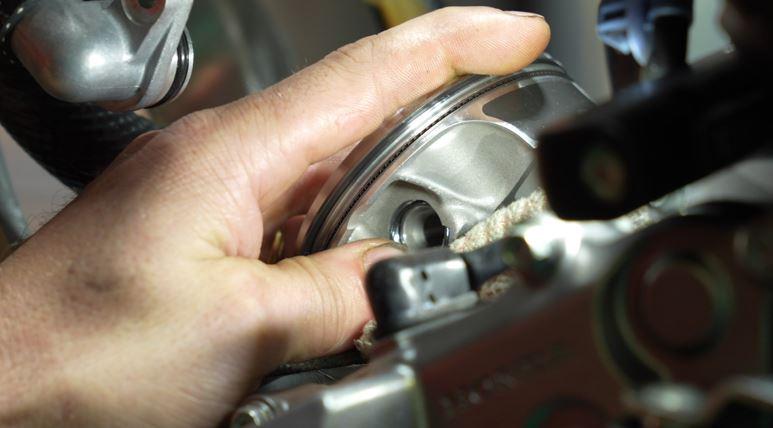
What causes engine knocking in motorcycles?
Using gasoline with an octane rating below the minimum specified for your motorcycle can cause engine knock, especially under heavy load. The octane rating tells you how well the fuel resists detonation. The higher the rating, the greater its resistance to knock.
Fuel with an octane rating below the minimum specified for your motorcycle can cause engine knock under load. Gasoline grades in the 95–101 octane range use the Research Octane Number (RON) scale in this context. In the US, gas pumps display the Anti-Knock Index (AKI), labeled (R+M)/2. When filling up in the US, use the minimum AKI specified for your motorcycle.
Other factors can also make a motorcycle engine more prone to detonation:
- Excessive ignition advance. If the spark plug fires too early, cylinder pressure builds while the piston is still rising on the compression stroke. This can cause the remaining air-fuel mixture to ignite before the flame reaches it.
- A lean air-fuel mixture under load. If the engine receives less fuel than intended under heavy load, combustion temperatures can rise and make knock more likely.
- High engine or intake temperatures. An overheating cylinder head or unusually hot intake air can make the unburned mixture more likely to ignite on its own.
- Carbon deposits. Deposits on the piston crown or elsewhere in the combustion chamber can reduce chamber volume, raising the effective compression ratio and increasing the risk of knock.
- Changes to the engine, intake, exhaust, or ECU. Modifications that alter compression, airflow, or ignition timing can affect the engine’s fuel and timing requirements. If pinging starts after a modification, have the fueling and ignition settings checked for the new setup.
Engine knocking in dirt bikes vs. street motorcycles: what’s different?
The underlying combustion causes are broadly similar, but riding conditions affect the risk. Street motorcycles can face sustained highway loads, high ambient temperatures and slow traffic that reduces cooling airflow, all of which raise combustion temperatures. Dirt bikes are often ridden at full throttle under load, and some are fitted with high-compression pistons, aftermarket exhausts or revised mapping that make fuel quality and ignition settings more critical.
Two-stroke and four-stroke engines also differ. On a carbureted two-stroke, incorrect jetting or an air leak at the intake or crankcase seals can lean the mixture and quickly overheat the piston crown. On a fuel-injected four-stroke, detonation can be linked to fuel grade, mapping changes or overheating. Check the service manual for your engine’s fuel, ignition, and jetting specifications.
How to diagnose engine knocking and distinguish it from other engine noises
Start with when and where you hear the noise. Does it appear on a cold start, at idle, or when you accelerate? Can you tell whether it comes from the cylinder head, lower in the engine, or near the exhaust? If it started after a fill-up, a service, or a change to the bike’s tuning, mention that to your mechanic. These details help narrow down what to check first. Don’t rev the engine or put it under load just to reproduce the noise.
- Detonation (engine knock). A sharp metallic ping under load, especially during acceleration, points toward abnormal combustion. If it started after a fill-up, check the fuel’s octane rating against the owner’s manual. On motorcycles equipped with a knock sensor, the ECU can retard ignition timing when it detects knock.
- Piston slap. A hollow slapping sound that is most noticeable on a cold start and fades as the engine warms up can point to excessive piston-to-cylinder clearance. If wear is suspected, a mechanic can measure the piston skirt and cylinder bore and compare the clearance with the service manual specification.
- Connecting rod bearing knock (rod knock). A deeper, rhythmic knock from the lower part of the engine may change with engine speed or load. Oil level and pressure are useful initial checks. Confirming bearing wear may require disassembly and inspection. If the oil pressure warning light comes on while riding, stop safely and shut off the engine.
- Valve or timing chain noise. On a four-stroke motorcycle, ticking near the valvetrain may warrant a valve clearance check. A rattle from the same area, particularly at startup, may point to the timing chain or its tensioner.
- Exhaust leak. A sharp tick near the exhaust port can sound like it’s coming from inside the engine. Once the exhaust has cooled, inspect the joint where the header meets the cylinder head for soot marks, a leaking gasket, or loose fasteners.
Further checks depend on what the initial inspection reveals. If detonation is suspected, spark plug condition can offer clues about combustion. If the oil level is dropping, check for engine oil leaks. Where internal damage is a concern, compression and leak-down tests help assess how well the cylinder seals, while a borescope inspection can reveal visible damage to the piston crown or cylinder wall. Bearing wear or excessive piston clearance may still be present even if compression is normal.

Is engine knocking dangerous? Risks of piston and engine damage
Repeated or severe engine knocking can damage your motorcycle’s piston, rings, and cylinder. Detonation can erode the piston crown or crack a ring land, the section of the piston between two ring grooves. If a ring land breaks, the piston ring can lose support and may no longer seal properly against the cylinder wall. A damaged ring or a loose fragment can also score the cylinder bore.
Pull over safely and shut off the engine if the knocking is severe or is accompanied by low oil pressure, overheating, sudden power loss, or unusual vibration. The sound alone can’t tell you how much longer the engine can run before a serious failure. Continuing to ride can make the damage worse and lead to more extensive repairs. If you suspect the piston has seized, see Athena’s guide to seized pistons in motorcycles.
How to fix engine knocking in a motorcycle
To correct engine knock, first identify what is causing the mixture to detonate. If the noise began after refueling, check the octane rating against the owner’s manual. If the fuel meets the specification and pinging persists, a mechanic can check ignition timing, the air-fuel mixture under load, and cooling system operation.
If inspection reveals damage from detonation, assess the piston crown, ring lands, rings, and cylinder bore before choosing a repair. Repairs may require new pistons and rings, cylinder honing or machining where permitted, cylinder replacement, or a more extensive engine rebuild. Cylinder construction and manufacturer specifications determine which operations are appropriate. For example, a cylinder with a plated bore, such as a nickel-silicon carbide coating, may not be honed or machined the same way as one with a cast-iron liner. A qualified shop should assess the cylinder’s condition and the available repair methods before selecting new parts.
Adjustments cannot repair parts that are already damaged, and a new piston will not prevent further detonation unless its original cause is corrected. Repair complexity and cost depend on the motorcycle and the extent of the damage; always follow the model-specific service manual.
Choosing Athena replacement pistons and gasket kits during engine repair
When inspection confirms piston or cylinder damage, whether from detonation or mechanical wear, select components according to the motorcycle’s make, model, year, engine variant, and measured dimensions. If the piston crown, ring lands, or ring grooves are damaged, inspect the piston rings and check the cylinder bore for scoring. Athena offers replacement pistons and piston ring kits, as well as motorcycle cylinders and cylinder kits when the cylinder needs replacing. When choosing a ring kit, check that it matches the piston and bore size.
Reassembly may also require top-end gasket kits or complete engine gasket kits, depending on the repair. The required components depend on how far the engine has been disassembled and which joints must be resealed. Correct fitment, clearances, and installation matter as much as selecting the right replacement parts. These components do not, by themselves, correct combustion knock.
How to prevent engine knocking and piston wear
To reduce the risk of detonation, use the manufacturer-recommended fuel octane and maintain the specified ignition settings, fuel mixture and cooling system. Avoid sustained high loads before the engine reaches its normal operating temperature.
For mechanical reliability, use the correct oil grade, maintain the oil level and follow service intervals. On dirt bikes, air-filter maintenance is especially important to limit abrasive contamination.
During a rebuild, measure piston-to-cylinder clearance and inspect the piston rings and cylinder bore. Do not assume that pistons and cylinders with the same nominal displacement share the same dimensions or tolerances. Use compatible replacement parts and follow the service manual for assembly procedures and torque specs. These checks help prevent the mechanical problems that can otherwise be mistaken for combustion knock.
Frequently asked questions about engine knocking
Can a knocking engine be fixed?
Yes. If detonation is caught early, correcting the fuel grade, ignition timing, or a fueling or cooling fault may resolve it. If repeated knock has damaged the piston, rings, or cylinder, those parts also need inspection and repair.
Is it safe to ride with a knocking sound?
No. A motorcycle with a new or unexplained knocking noise shouldn’t be considered safe to ride until the cause has been assessed. Persistent knocking, low oil pressure, overheating or sudden power loss may indicate serious internal damage. In these situations, stop safely, shut off the engine and seek professional inspection.
Is it expensive to fix engine knocking?
Costs depend on the cause and extent of damage. Fuel or ignition adjustments usually cost less than piston replacement, cylinder repairs, or a full rebuild.
Is it worth fixing engine knock?
In many cases, repairing engine knock is worthwhile, particularly when the cause can be corrected without extensive internal work. When deciding, consider the severity of the damage, the motorcycle’s overall condition and market value, parts availability and the estimated repair cost compared with rebuilding or replacing the engine.
How long will an engine last after it starts knocking?
There’s no reliable way to predict how long an engine will run once detonation begins. Its severity and the load on the engine affect how quickly damage develops. If you hear severe knocking, stop safely and shut off the engine.
Does engine knock mean the engine is blown?
Not necessarily. Detonation can occur before the piston or cylinder suffers lasting damage. Persistent or severe knock warrants inspection for damage to the piston crown, ring lands, rings, and cylinder wall.
Modificato il 25 November 2026


Ask the expert
-
 Ask the expertMoto
-
 Ask the expertAuto
-
 Ask the expertMoto