

Leaking Rear Main Seal: Symptoms, Causes and How to Fix It
The rear main seal may be a small component, but a leak from this area can lead to a costly repair, mainly because of the work required to reach and replace it. The reason comes down to location. The seal sits at the very back of the crankshaft , tucked into the narrow space where the engine meets the transmission. The part itself costs little; reaching it is what runs up the bill.
That gap between a cheap component and a labor-heavy job is exactly why a rear main seal leak is worth understanding before you start throwing parts at it. Knowing what the seal does, how to tell a real leak from a lookalike, and why installation makes or breaks the repair can spare you from replacing parts you don’t need or driving on dangerously low oil.
What is a rear main seal and why can it leak?
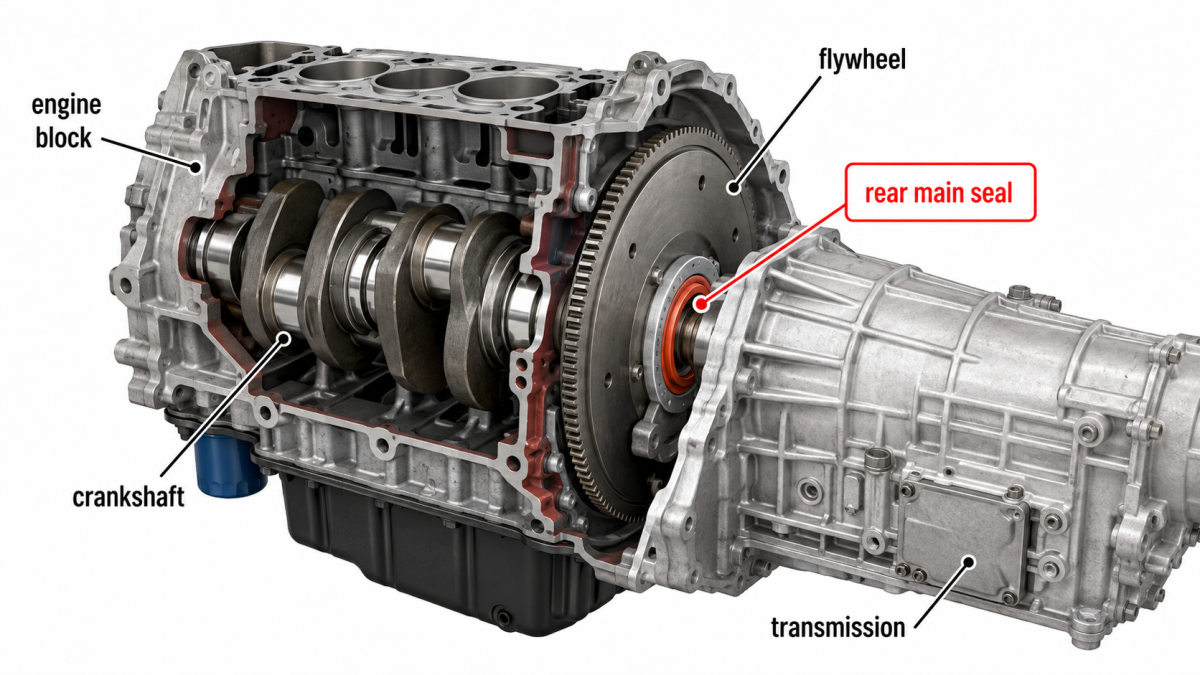
The rear main seal is fitted at the rear end of the crankshaft, where the shaft exits the engine toward the flywheel or flexplate. Its one job is to keep engine oil inside the crankcase while the crankshaft spins.
The seal does that job in a punishing spot. The sealing lip has to ride against a shaft turning at thousands of rpm, shrug off heat, sit in constant contact with oil and hold its shape for tens of thousands of miles. Sooner or later something gives: the material hardens or wears, the lip loses contact with the crankshaft, or a botched installation leaves a gap. Once that happens, oil works its way out and pools around the bell housing.
Rear main seal, crankshaft oil seal and engine oil seals: what is the difference?
These terms cause more confusion than they should. A rear main seal is simply a crankshaft oil seal that lives at the back of the engine, on the transmission side, sealing oil in while the crankshaft turns. It belongs to the wider family of engine oil seals, but in practice the label matters far less than three things: where the seal sits, how it works and how it has to go in.
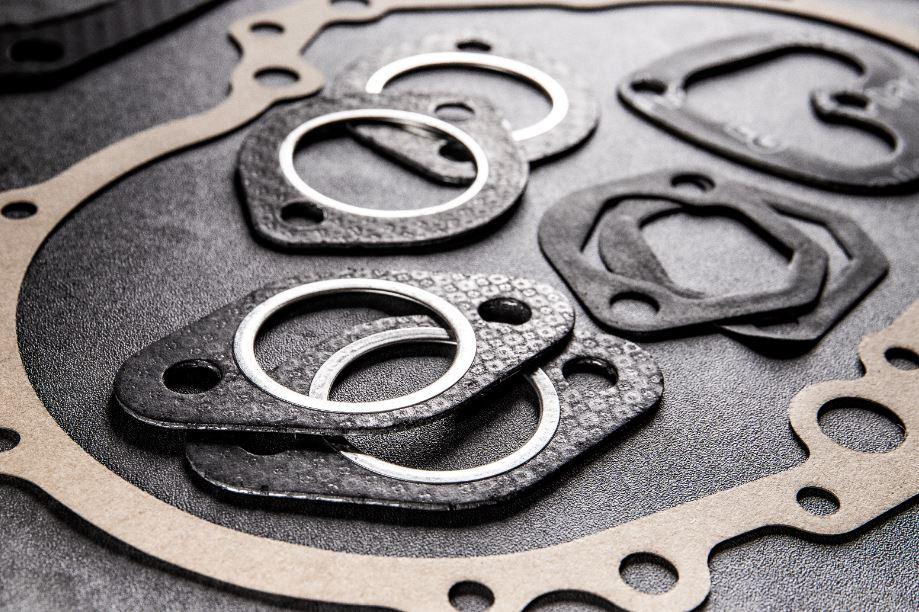
The distinction that does matter is the one between an oil seal and a flat gasket. A gasket seals two surfaces that don’t move, like an oil pan bolted to the block. An oil seal has the harder task of sealing against something that spins, which is why fit is everything: the lip has to stay seated against the crankshaft, or it won’t hold.
On a lot of modern engines the rear seal comes as a flanged seal or integrated carrier rather than a plain ring you press into place. The flange has to be aligned and bolted to the block, and on some engines it even carries a reference point for the crankshaft position sensor. Get the alignment wrong and you’ve done more than create an oil leak; you can throw off how the engine runs.
The practical takeaway is that oil near the transmission isn’t automatically a rear main seal. The symptoms have to be read carefully, and other sources ruled out, before the seal takes the blame.
Rear main seal leak symptoms: the most common signs
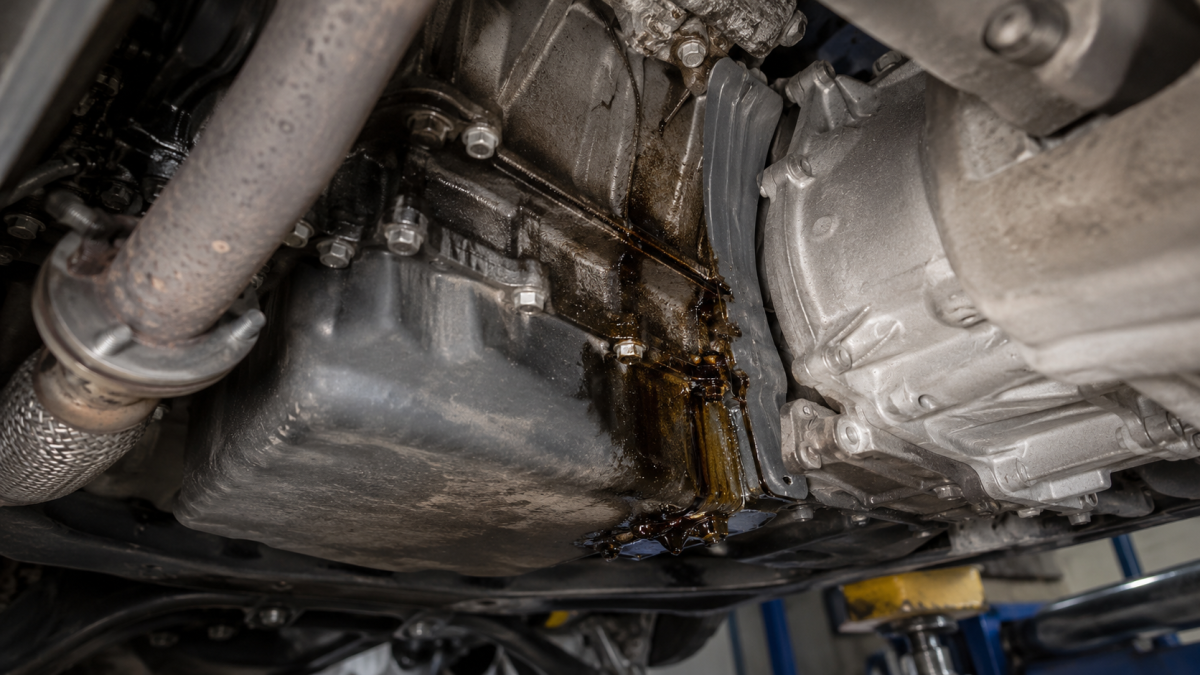
The classic sign of a rear main seal leak is engine oil showing up at the back of the engine, around the seam where it bolts to the transmission. But oil travels with gravity, airflow and vibration, so the spot where it drips is rarely the spot where it started.
A slow leak might be nothing more than a damp, oily film. A faster one leaves spots on the floor, soaks the lower bell housing or slowly pulls down the oil level. Catching it early tells you whether you can keep an eye on it or need to get under the car now.
On a car, the usual signs of a rear main seal leak are:
- oil dripping from between the engine and transmission;
- oil stains under the car after it’s been parked;
- a wet or oily bell housing;
- a steadily dropping oil level;
- a burning-oil smell when oil reaches hot exhaust parts;
- on a manual, clutch slip, chatter or poor engagement.
That last one deserves attention. On a manual transmission, leaking oil can reach the clutch disc, flywheel or pressure plate and cause slipping or shuddering. On an automatic, the oil usually gathers around the bell housing or flexplate, but it still needs a proper look, because it’s easy to confuse with transmission fluid weeping from something nearby.
Does a rear main seal leak when parked?
A rear main seal can leak when the vehicle is parked, and the leak often shows up worst after a drive. A warm engine means warm, thin oil that slips past a tired sealing lip more easily. Switch the engine off and that oil keeps draining down to the lowest point of the bell housing, which is why the stain often appears a while after you park rather than the moment you shut off.
The shape of the stain, the oil level and where exactly the oil lands all help point to the source.
Why does the leak sometimes appear after 15 minutes of driving?
Some rear main seal leaks stay hidden until the engine is fully warmed up. Heat thins the oil, expands the metal slightly and shifts crankcase pressure as the crankshaft spins, and only then does a small leak begin to weep.
It’s easy to read that delay as an intermittent or unrelated problem, when really the leak just needs heat, oil flow and a turning crankshaft before it gives itself away.
What does a rear main seal leak look like?
A rear main seal leak usually shows up as oil around the lower joint between the engine and transmission. It may sit at the bottom of the bell housing, drip from the lower transmission area, or spread along the oil pan, crossmember and underbody panels depending on how the engine is laid out.
The catch is that oil rarely falls straight down from where it escapes. Airflow under a moving car pushes it backward, gravity carries it down from a higher leak to the same low point, and road grime sticks to it and leaves a dark, greasy smear. That’s why you can’t diagnose this leak by where the oil lands alone.
What can be mistaken for a rear main seal leak: oil pan gasket, valve cover gasket or transmission fluid leak
Plenty of other leaks can pass for a rear main seal leak. Oil from a valve cover gasket, oil pan gasket, oil filter housing, camshaft seal, oil pressure sensor or rear engine cover can all run down the back of the engine and collect near the bell housing. Because the rear main seal sits so close to the oil pan and transmission, it tends to get blamed first.
A proper diagnosis usually starts low-tech: clean the back of the engine and the bell housing, run it, and watch where fresh oil shows up first. If the area is too oily to read, a technician can use leak-detection dye or another tracing method to tell a true rear main seal leak from oil drifting down from the valve cover, oil pan, filter housing or somewhere else. Skip this step and you can end up paying to replace a seal that was never the problem.
Transmission fluid can pool in the same area too, but it isn’t engine oil: color, smell, viscosity and a fluid-level check will usually tell the two apart. Only once you’ve found the real source is it worth asking why the seal failed in the first place.
What causes a rear main seal to leak?
Most rear main seal leaks come down to wear, heat, age and the lip losing solid contact with the crankshaft. Rubber and PTFE sealing materials stiffen over the years, while the crankshaft surface can pick up wear, grooves or deposits that stop the seal from sealing cleanly.
High mileage is the usual suspect, but not the only one. A new seal can leak too if it went in wrong: pinched, nicked, cocked or pushed to the wrong depth. Crankcase pressure is another big one. The PCV (positive crankcase ventilation) system bleeds off pressure and vapor from inside the engine; when it clogs or stops working, that pressure has to go somewhere, and it pushes oil past seals and gaskets.
Replace the rear main seal but ignore a failing PCV system and you may be back under the car before long, watching a perfectly good seal leak all over again.
Other things that can contribute:
- too much oil in the engine;
- contaminated or worn-out oil;
- overheating;
- long spells sitting unused;
- the wrong seal material for the application;
- a damaged crankshaft sealing surface.
The lesson is that a good repair isn’t just about pulling out the old seal. The crankshaft surface, the crankcase ventilation and the nearby gaskets all deserve a look too.
Rear main seal leak repair: how do you fix it?
The real fix for a rear main seal leak is almost always replacing the seal. Stop-leak additives might slow a very minor weep for a while, but they can’t mend a torn lip, undo a bad installation, resurface a worn crankshaft or relieve crankcase pressure, so they’re a stopgap at best, and you should always follow the label.
On most modern cars, getting to the seal means dropping the transmission, pulling the flywheel or flexplate and removing whatever else is in the way; on some, the engine has to come out entirely. That’s where the cost lives: the labor dwarfs the price of the seal itself.
For that reason it’s usually a job for a qualified technician, especially on cars with automatics, dual-mass flywheels, awkward drivetrain layouts or integrated seal carriers.
Correct rear main seal installation: why the fitting sleeve matters
Installation is where a new seal lives or dies, because a fresh seal will leak just as readily as an old one if it’s damaged going in. It has to go in square, to the right depth, and slide over the crankshaft without the lip folding or tearing. That’s the whole point of the fitting sleeve that often comes in the box.
The sleeve is a temporary plastic or metal guide that lets the lip glide over the crankshaft without rolling under, stretching or cutting. Pull it off too soon, force the seal by hand or start it crooked, and you can wreck the lip before the engine ever turns over.
With PTFE seals, the sleeve also keeps the lip in shape until it’s seated. Some seals go in dry, others need a light film of oil. That’s not something to guess at, so follow the seal maker’s instructions and the repair procedure for the car.
And if the crankshaft sealing surface is scored, grooved or worn, a new seal alone won’t save you; the surface it rides on has to be right too. The seal is only half the repair.
Rear main seal leak repair cost: why can it be expensive?
The cost of fixing a rear main seal leak swings widely with the car, the engine layout, the transmission type and local labor rates. The seal is rarely the pricey part: the work to reach it is.
Dropping the transmission, supporting the drivetrain, pulling the flywheel or flexplate and putting it all back correctly can eat up hours. While everything’s apart, related parts like clutch components, flywheel bolts, transmission seals or lower engine gaskets are often worth inspecting or replacing too. All the more reason to diagnose carefully before you commit.
When it makes sense to replace other seals and gaskets
If the transmission or engine is already out, it’s often smart to check the other seals while you’re in there. On a high-mileage engine, several gaskets tend to be aging at the same pace even if only one is leaking yet.
A technician might look over the oil pan gasket, rear cover gasket, valve cover gasket and crankshaft sealing surface along with any reachable lower-engine seals. For a full engine overhaul, a complete gasket kit with oil seals makes sense, but for a straightforward rear main seal job, the part you choose should match the specific engine and the actual scope of the work.
Oil seals and gasket kits for rear main seal repair: Choose Athena | Guarnitauto
With any oil leak, the quality and fit of the sealing part are what count. A rear main seal has to match the engine, the material spec, the crankshaft dimensions and the way it installs. A part that merely looks right but misses those specs is a repeat leak waiting to happen.
Athena | Guarnitauto makes oil seals for cars and engine gasket solutions built for repair and overhaul work, backed by long experience in engine sealing and a focus on reliable oil control and proper fit. For rear crankshaft work, the seal has to suit the specific engine, and the sealing surface and installation method always need checking.
Athena | Guarnitauto oil seals for cars are built to OE-equivalent specifications for the engine they’re meant for. During a rear crankshaft seal replacement, picking the right part matters, but so do surface inspection, alignment and careful installation. For bigger jobs, Athena | Guarnitauto engine gaskets and complete engine gasket kits with oil seals can cover a wider resealing effort, as long as the kit includes the parts that engine actually needs.
The goal isn’t just to swap a leaking part; it’s to put the whole sealing system right.
FAQ: Rear main seal leak
Stop leak for rear main seal: does it really work?
A stop-leak product might quiet a very minor weep from an aging seal for a while, but it’s not a repair. It can’t fix a torn lip, a badly fitted seal, a worn crankshaft, excess crankcase pressure or oil that’s already soaked into the clutch. If the leak is active, the oil level is dropping or the car isn’t driving right, get it inspected and fixed properly.
Is it safe to drive with a rear main seal leak?
It depends on how severe the rear main seal leak is. A minor seep can be watched for a while as long as the oil level holds and there are no warning lights, burning smells or clutch symptoms. But active oil loss, an oil-pressure warning, smoke, a burning smell or a contaminated clutch mean it needs looking at right away. Running an engine low on oil can destroy it.
How much does it cost to fix a rear main seal leak?
The repair cost varies, because most of the bill is labor. Reaching the seal usually means removing the transmission or other drivetrain parts, so the car’s layout, the transmission type and whether you replace related parts at the same time all move the final number.
Can a rear main seal leak damage the clutch?
Yes, a rear main seal leak can damage the clutch. On a manual, oil from the seal can reach the flywheel and clutch disc. A contaminated clutch may slip, chatter, shudder or engage poorly, and at that point, replacing the seal alone may not be enough if the clutch has already soaked up oil.
Modificato il 10 July 2026


Ask the expert
-
 Ask the expertMoto
 -
 Ask the expertMoto
 -
 Ask the expertMoto