

What is the purpose of a motorcycle starter relay, the symptoms of failure, and how to test it
The motorcycle’s starter relay is a fundamental component of the ignition circuit: its function is to allow the passage of the current required to activate the starter motor and start the vehicle. When the relay does not work properly, various issues may arise during engine start-up, which must be recognized and accurately diagnosed.
When this component does not operate correctly, several irregularities may appear during engine start-up, and these must be recognized and properly diagnosed. In this article, we will examine what the starter motor relay is and what it is used for, where it is typically located within the motorcycle, which symptoms may indicate a malfunction, and how to perform diagnostic tests. We will also look into alternative causes that can lead to similar issues, offering practical guidance on replacing the relay and choosing the most suitable one, with a focus on Athena components, designed to ensure reliability, compatibility, and consistent performance over time.
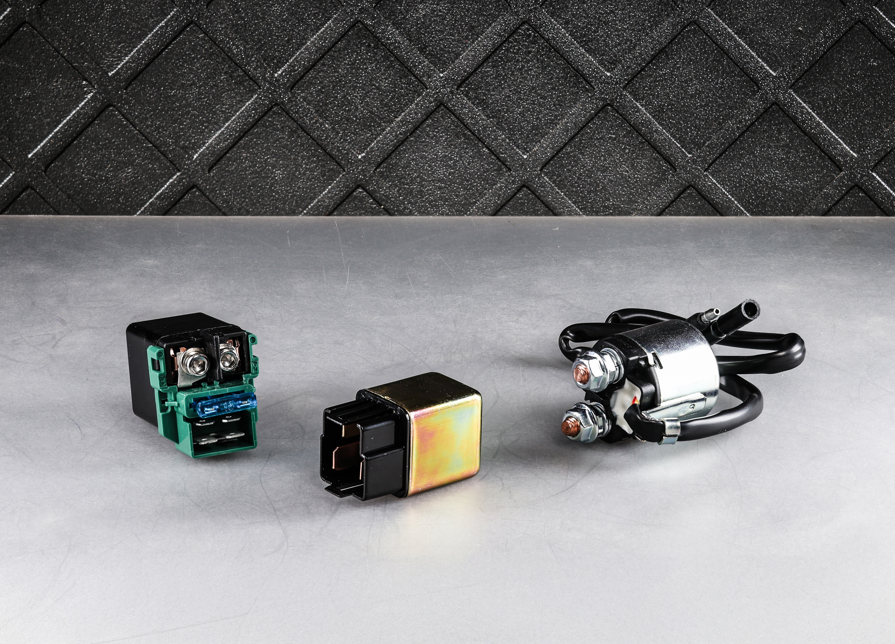
What the starter motor relay is and what it is used for
The starter relay is an electromechanical component that switches the high current coming from the battery to the starter motor, using a low-intensity control signal sent by the start button. In other words, it acts as an automatic power switch, capable of connecting the battery to the starter motor only when engine start-up is requested.
When the rider presses the start button, a small current energizes the relay coil, which then closes the main circuit. This allows the current coming from the battery to reach the starter motor, enabling the engine to turn over and start. Once the engine is running, the circuit opens again, cutting off the flow of high-intensity current.
In summary, the starter relay’s function is to protect the electrical circuit and ensure a safe and efficient start-up, reducing contact wear and improving the overall longevity of the ignition system.
Where the starter motor relay is located on a motorcycle
The location of the starter relay may vary depending on the type of motorcycle, the layout of the electrical system, and the manufacturer’s design choices. In general, this component is placed near the battery or the starter motor, as it must ensure a direct connection with minimal current loss between these two elements.
In most models, the relay is mounted on a metal or plastic bracket on the frame, often under the seat or inside the side compartment where the main electrical components are housed. Some sport-oriented motorcycles or smaller bikes, however, have the relay integrated into the starter motor itself—a solution that reduces overall bulk but makes replacement more complex.
To visually identify the starter relay, simply look for a component that is generally rectangular or cylindrical in shape, with two large-diameter main terminals (connected to the battery and the starter motor) and one or two smaller connectors for the control circuit. Often, one or more integrated fuses are also present and mounted on the relay body, protected by a transparent cover.
A practical tip: before working on the component, always consult the wiring diagram for the specific motorcycle model to verify the exact location and cable numbering. This helps avoid identification mistakes or incorrect connections during testing or replacement procedures.
Symptoms of a faulty starter relay
A damaged or worn-out starter relay may show a series of easily recognizable symptoms, which directly affect the engine’s ability to start properly. Identifying these signs allows you to quickly pinpoint the source of the issue and prevent damage to other components of the electrical system.
1. Audible click but the engine does not turn over
When the start button is pressed, a sharp click can be heard, but the starter motor does not engage. This behavior indicates that the relay’s internal coil is receiving the control signal, but the power contacts are unable to close properly. The most common causes are:
wear or oxidation of the internal contacts, which prevents current from passing through;
voltage drop caused by corroded or poorly connected wiring.
2. No response when starting
If turning the key or pressing the start button produces no sound at all, the relay may not be receiving power or may have an internal coil failure. In many cases, however, the cause is simpler: for example, a blown fuse—meaning a fuse that has opened to protect the circuit from an overload—preventing the relay from receiving current.
Another possible cause is a faulty safety switch (such as the side-stand switch, clutch switch, or neutral sensor). These devices prevent the engine from starting when safety conditions are not met. If one of them is damaged, dirty, or has oxidized contacts, it may interrupt the control signal and make the relay seem defective, even though it simply isn’t receiving permission to activate.
3. Intermittent or slow starting
A relay that operates irregularly, causing slow or intermittent starting, may have unstable internal connections or a partially broken circuit. These symptoms often worsen with vibrations or when the component heats up during motorcycle operation.
4. Overheating or burning smell
An overheated relay is a sign of abnormal electrical resistance in the contacts or excessive current draw from the starter motor. In addition to compromising the relay’s functionality, this condition can damage the wiring and surrounding connections.
The starter motor relay is not working: alternative causes
When the starter motor fails to engage, the relay is often one of the first components suspected. However, in many cases the problem does not lie in the relay itself, but in other elements of the starting circuit. Before proceeding with replacement, it is therefore advisable to check a series of possible alternative causes that can mimic a relay fault or compromise its operation.
1. Power supply issues
A discharged or worn-out battery is among the most common causes of starting failure. A voltage below 12 V may not be sufficient to energize the relay coil or to properly power the starter motor. Corroded or loose terminals can also cause voltage drops, resulting in isolated clicks or no response at all.
2. Blown fuses in the starting circuit
A blown fuse along the power supply line prevents the relay from receiving current or from sending the power signal to the starter motor. In many models, the main fuse is integrated into the relay body itself; in other cases, it is placed in a separate fuse holder. Testing should always be done with a multimeter or test lamp, never through visual inspection alone.
3. Damaged wiring or loose connectors
Worn, bent, or damaged wires with compromised insulation can lead to current leakage or false contacts, interrupting the transmission of the start signal. Corroded connectors at the relay, the start button, or the starter motor can also cause intermittent malfunctions. A thorough inspection of all connections and cleaning with a proper electrical contact spray are recommended steps.
4. Faults in the start button or control circuit
The start button sends the activation signal to the relay. If this component has oxidized or faulty internal contacts, the relay will not receive the control impulse. In some motorcycle models, the control circuit also passes through safety devices (clutch switch, side-stand switch, neutral sensor) which, if defective, interrupt the starting chain.
5. Starter motor failure
Finally, it is possible that the starter motor itself is the real cause of the problem. Worn brushes, a seized rotor, or an armature winding failure can prevent the engine from starting even if the relay is functioning properly. In such cases, during testing the relay will click normally, but the starter motor will not respond.
How to test the starter motor relay
Testing the starter motor relay is a relatively simple operation, but it must be carried out carefully and by following the correct procedures. Before performing any test, it is always advisable to consult the workshop manual for your motorcycle or contact a qualified mechanic, ensuring safe operation and compliance with the manufacturer’s specific instructions.
Required tools
To perform an accurate diagnosis, you will need:
A digital multimeter (with voltmeter and ohmmeter functions);
Test leads with insulated clamps;
A 12 V battery or the motorcycle’s own power supply;
A jumper wire or bridge cable for direct functional tests;
Insulated gloves and protective eyewear.
1. Checking the continuity of the contacts
With the relay disconnected from the system, set the multimeter to Ohm (Ω) mode and check the continuity between the main terminals.
If the contacts are permanently closed, the relay is short-circuited.
If they remain open even when the coil is powered, the relay is broken or the contacts are worn.
2. Coil excitation test
Connect the relay’s control terminals to the positive and negative poles of a 12 V battery.
When power is applied, a clear click should be heard, indicating that the coil has activated the internal mechanism.
During this test, with the multimeter connected to the power terminals, the circuit should close: the resistance must drop to values close to 0 Ω (typically below 0.2 Ω).
3. Measuring the coil resistance
With the relay disconnected, measure the coil resistance between the control terminals.
The typical value depends on the model but generally ranges between 3 and 5 Ω.
Values close to 0 Ω indicate a short circuit in the coil; values above 10 Ω or lack of continuity indicate a break in the internal winding.
Athena motorcycle starter relays and how to choose the right one
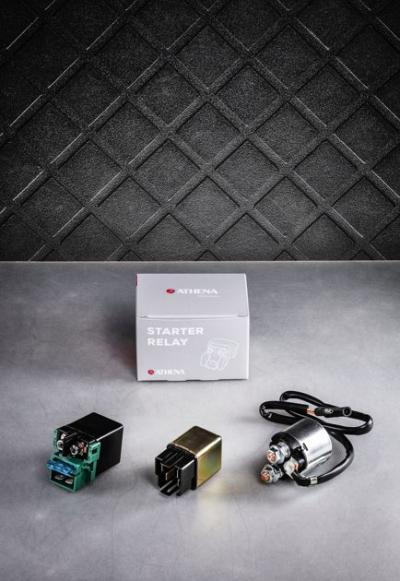
Athena offers a complete range of starter relays designed for major motorcycle, scooter, and ATV brands and models. Each component is engineered to ensure maximum reliability, compatibility, and long-term durability, while complying with the original manufacturer’s (OEM) electrical specifications.
Athena relays are individually tested to guarantee proper current switching and high resistance to vibrations, temperature fluctuations, and the demanding conditions typical of motorcycle use.
To quickly identify the correct replacement part, you can use the code catalog and the search system on the athena.eu website, which allows you to filter products by brand, model, year of the vehicle, technical specifications, and original equipment (OE) code, helping you avoid compatibility errors and select the most suitable relay for your motorcycle.
Alternatively, you can always contact your Athena dealer or service center for assistance in choosing the most appropriate component.
Modificato il 16 February 2026


Ask the expert
-
 Ask the expertMoto
 -
 Ask the expertMoto
 -
 Ask the expertMoto